Atlantis (page 3)
In the Ermitage Papyrus in Leningrad there are lamentations about a terrible catastrophe, when heaven and earth turned upside down. After this catastrophe darkness covered the earth ― perhaps a nuclear winter, usually caused by huge volcanic eruptions or an asteroid collision. This "shadow of death" is related to the time of the wandering in the desert after the Exodus from Egypt.
The sinister meaning of the words "shadow of death" corresponds with the description of the Ermitage Papyrus: "None can live when the sun is veiled by clouds." The phenomenon of gloom enduring for years impressed itself on the memory of the Twelve Tribes and is mentioned in many passages in the Bible:
Psalms 44:19 - "The people that walked in darkness .. in the land of the shadow of death."
The Manuscript Quiche of the Mayas also tells that in the Western Hemisphere, in the days of a great cataclysm, when the earth quaked and the sun's motion was interrupted, the water in the rivers turned to blood.
| 
| | | 
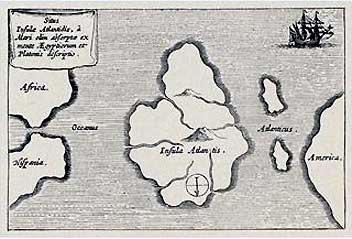
| | | | Map of Atlantis by the 17th century German scholar Athanasius Kircher. He based it on Plato's description of Atlantis as an island west of the Pillars of Hercules — the Strait of Gibraltar — and situated in the ocean that has since been named after the legendary land. Unlike modern cartographers, he placed south at the top of the map, and America appears at the right. . . — Buy this Art Print at AllPosters.com. |
| | |
| |
Another ancient document, the Papyrus Ipuwer, also states: "the earth turned upside down" and "the land turns round (over) like a potter's wheel. The river is blood", and this corresponds with the Book of Exodus 7:20: "All the waters that were in the river were turned to blood."
Was this terrible catastrophe a volcanic upheaval that changed the face of the Earth? Or perhaps a meteor from outer space that hit us with catastrophic consequences? Whatever it was, it certainly made an impression in our ancestors.
|

Forbidden Archeology: The Hidden History of the Human Race
Over the centuries, researchers
have found bones and artifacts proving that humans like us have
existed for millions of years. Mainstream science, however, has
suppressed these facts. Prejudices based on current scientific
theory act as a "knowledge filter," giving us a picture of
prehistory that is largely incorrect. "Forbidden Archeology" is
a superb, well-documented compendium of both the evidence
favoring the conventional picture of human evolution, and the
anomalous evidence that casts this picture into doubt.

|
| |
If the eruption of a single volcano can darken the atmosphere over the entire globe, a simultaneous and prolonged eruption of many volcanoes would blacken the sky. The author of Codex Chimalpopoca, John Bierhorst, in his history of the suns, tells us of a terrifying celestial phenomena. . . followed by darkness that covered the face of the earth, in one instance for a period of 25 years.
To all the speculation, modern geologic theory now adds a tantalizing footnote. It is believed today that, in the not so distant past, an extraordinary period of flooding may have caused the filling of the Mediterranean sea. In fact, scientist believe that the area has been subject to many different massive floods throughout pre-historical times. Also, extensive glaciations in the recent geological past have resulted in repeated changes in worldwide sea levels. During the period of the last glacial maximum, about 17,000 to 18,000 years before the present, sea level was 100 to 120 meters lower than it is today. Any of these recent geological changes could have originated the events and stories recounted in the Atlantis mythology.
Around the shores of the Mediterranean, on its European, Asian, and African coasts, are sunken structures, often visible when the sea is smooth. Some are the remains of ancient harbor works, as at Sidon and Tyre and Alexandria. Some are villas or the floors of temples, as at Posilipo on the Bay of Naples or at Kenchreai on the Gulf of Corinth. Some are entire waterfronts of lost cities, with roads leading into the water and stairways descending out of sight.
These constitute evidence that world sea levels have changed many times, even during recent periods, and if not as dramatically and sudden as described by Plato in his Atlantis' stories, certainly as disrupting and concluding, particularly for the peoples that lived in these once above sea-level areas. It is entirely plausible that, many thousands of years ago, an unknown advanced civilization, anywhere in the world, even in or near the Mediterranean, encountered its demise in a vast, abrupt, and unexpected cataclysm.
Was this what happened approximately 12 thousand years ago, spelling the end of a civilization that only reaches us in the form of legend? Or is Atlantis just a figment of an overactive collective imagination?
| | | | | |
| | |
| |
For a final enticing piece of information, in December 2001 explorers using a miniature submarine to probe the sea floor off the coast of Cuba revealed their discovery of stone structures deep beneath the ocean surface that were indicative of ruins left by an unknown human civilization thousands of years ago. Representatives of the Canadian-based Advanced Digital Communications and experts from the Cuban Academy of Sciences declared that the structures were discovered at a depth of around 2,100 feet and were distributed as if remnants of an urban area. Estimates of the ancient city under the sea were somewhere in the vicinity of 6,000 years, thus making them about 1,500 years earlier than the great Giza pyramids of Egypt. Whether this new fascinating discovery proves to be Atlantis or indication of a land bridge that once connected Cuba to mainland Latin America, it is sure to be controversial.
| | | | | |
| | |
| |
Of all the world's unsolved puzzles, Atlantis is probably the biggest, exerting a mysterious influence over humankind for thousands of years. The passage of time has not lessened interest in the legendary continent, nor have centuries of skepticism by scientists and scholars succeeded in banishing it to obscurity.
See Mu, Lemuria, Love Spells -- Use these powerful love spells to help you find and keep your true love, Unbroken Curses, Mystic Gifts and Charms - New Age Gift Shop & Wicca and Pagan Supplies, The Chakra Store, The Tarot Store, Divination & Scrying Tools and Supplies, Unique Amulets, Talismans, Good Luck Charms, and Love Tokens, Powerful Witch Doctor Spell Kits, Powerful Spells - Cast by Andreika the Witch, Webmasters Make $$$, AzureGreen - Celebrating All Paths to the Divine, ISIS - Tools for Your Soul's Journey, and The Pyramid Collection - Myth, Magick, Fantasy and Romance.
Sources: (1) Dictionary of the Occult, Caxton Publishing; (2) Into the Unknown, Reader's Digest Association, Inc; (3) Braymer, Marjorie, Atlantis: The Biography of a Legend, Atheneum; (4) Donnelly, Ignatius, Atlantis: The Antediluvian World, Dover Publications; (5) Mysteries of the Deep, American Heritage Publishing Co., Inc; (6) Mysteries of the Unknown, Time-Life Books; (7) Muck, Otto, The Secret of Atlantis, Pocket; (8) Spence, Lewis, The History of Atlantis, Dover Publications; (9) Wilson, Damon, Lost Worlds, London Bridge; (10) Mysteries of Mind, Space & Time: The Unexplained, H. S. Stuttman Inc. Publishers; (11) Steiger, Brad and Sherry H., The Gale Encyclopedia of the Unusual and Unexplained, Thomson Gale.
| | |







 .
. .
.