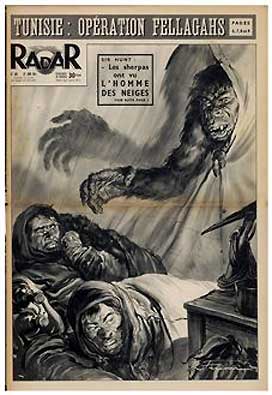
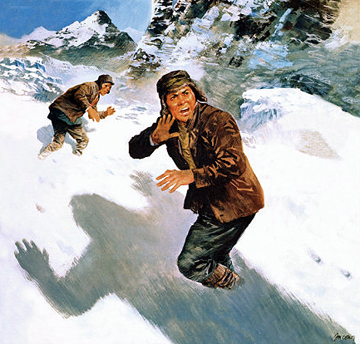
Sherpas guiding a Japanese Everest Expedition are woken by a Yeti peering into their tent . . . — Buy this art print at AllPosters.
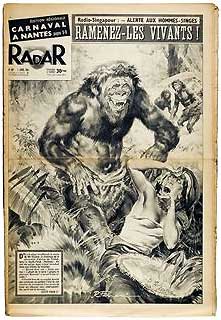
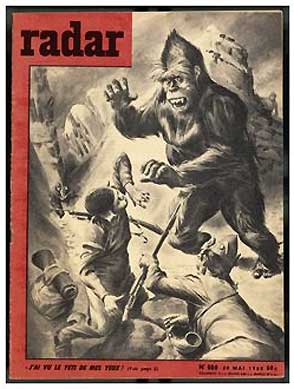
Ever since European travelers began to explore Tibet they have reported legends of the huge ape-like creatures the locals called Metoh-kangmi, which translates roughly as filthy or abominable snowman. Stories about strange hairy man-like beasts reached Europe as early as the 15th century, but it was not until the 19th century that the subject began to arouse interest in the West.
In 1832, a report from the U.K. representative in Nepal (B.H. Hodson) described a hirsute creature who reportedly had attacked his servants. The natives called the beast 'rakshas', which means 'demon'. A report was published in the 'Journal of the Asiatic Society of Bengal', In it, B.H. Hodson concluded that he had seen an unusually large, upright orangutan (though these apes only live in the tropical jungles of Malaysia and Indonesia). This appears to be the first report of the Abominable Snowman made by a Westerner.
More than half a century later, in 1889, Major Lawrence Austine Waddell of the Indian Army Medical Corps, while exploring the Himalayas, came across huge footprints in the snow at 17,000 feet; his bearers told him that these were the tracks of a Yeti, a ferocious creature which was quite likely to attack humans and carry them off for food, and that the best way to escape it was to run down the mountain, for this beast had such long hair it would fall over its eyes and blind it when in their pursuit going downhill.
Then, in 1913, reports surfaced that a group of Chinese hunters had wounded and captured a hairy man-like creature, that the locals soon named the "snowman". This creature was supposedly kept captive in Patang at Sinkiang Province until it died five months later. It was described as having a black monkey-like face and a body covered with silvery yellow hair several inches long; it's hands and feet were man-like and the creature was incredibly strong. It grunted and made guttural noises, but mostly made loud whistling sounds. Incredibly, no photographs were ever reported taken or produced from this incident.
A year later in 1914, J. R. P. Gent, a British forestry officer stationed in Sikkim, wrote of discovering footprints of what must have been a huge and amazing creature.
Again, in 1921, an expedition led by Col. C. K. Howard-Bury (later Sir) climbing the North face of Mount Everest reported seeing a group of large creatures moving in the snow at the Laptha-La pass. Two years later another Mount Everest climbing expedition, this time led by Major Alan Cameron, observed a line of huge and dark creatures moving along a cliff face high above the snowline. Pictures of the creatures' tracks were taken two days later, when the expedition reached the area where they were seen.
In 1925 a Greek photographer and member of the Royal Geographical Society named N. A. Tombazi glimpsed a creature he later described as "exactly like a human being, walking upright and stopping occasionally to uproot or pull some dwarf rhododendron bushes." Tombazi, who was at about 15,000 feet up in the mountains on the Zemu glacier, later reached the spot where he sighted the creature, only to also find some intriguing tracks in the snow.
Stray discoveries of extraordinary tracks, glimpses of unidentifiable man-beasts and reports of bizarre attacks by alleged Yetis slowly increased in the second quarter of the 20th century, but most Westerners believed that the Snowman's true habitat was the realm of fantasy.
Then in November 1951, an impressive report was made by British mountaineers and Everest explorers Eric Shipton and Michael Ward (First Everest Reconnaissance Expedition), who crossed the Menlung Himalayan glacier and photographed giant footprints at about 20,000 feet above sea level. The prints measured thirteen by eighteen inches, and were described as having three small toes and a huge big toe that seemed to be almost circular. At the time the two climbers insisted that the tracks looked like were made by a two-legged creature, and certainly not a wolf or bear. However, tracks left in snow tend to enlarge when exposed to direct sunlight, and this may well explain many of the accounts of Snowman tracks, since smaller tracks of native animals tend to spread under warmth. Ward and Shipton could also have been influenced by their Sherpa mountain guides, who immediately identified the tracks as Yeti footprints.
Abominable Snowman hunts became the rage during the 1950s and 1960s, but fell off when nothing turned up. Although occasional reports of tracks found and sightings made continued to trickle in throughout the following years, they remained inconclusive. So, the mystery surrounding the existence of this creature still persists.
This website is best viewed with the latest
versions of
Microsoft
Internet Explorer or
Firefox.
Occultopedia
makes extensive use of
Flash and Scripting in its pages and interface. Make certain your browser
permissions are set
accordingly and that you have the latest
Flash plug-in for the full experience, proper look and accurate
layout. You can do it with confidence. This site does not contain any viruses, malicious software
or scripts.
Occultopedia is the genuine article, the
original and the best internet index of the extraordinary and uncanny,
shamelessly copied by many, but never equaled. Online since 1995 — at first in a free web space provider
(Tripod.com), and in 1997 finally
with its own domain name and hosting — Occultopedia still is the
principal online resource for those looking for the unexplained, the
curious and the unusual.
Occultopedia respects your privacy. As
such, no cookies or any other tracking software will be installed as a
part of this website's original programming. I do not seek to obtain any personal information
beyond what is volunteered through electronic communications
(e.g. emails & forms).
Occultopedia may appear to be a for profit site, but my site is
not in reality a commercial one. All of the commercial links are from affiliate
programs, and the little revenue I get from these is to pay for hosting,
bandwidth — that can be quite costly if you have a lot of traffic, graphics and
pages — and any other expenses related to Occultopedia's upkeep, support, and maintenance.
For more details, visit my
ordering
information page.
Occultopedia is a
FREE online
resource available to the whole world. Usage of my word definitions and articles
by educational institutions, teachers and students alike, is here by granted.
Reproduction for profit, and for display in another web site is strictly
forbidden, and will be handled as copyright infringement and prosecuted to the
full extent of the law. However, if you follow
some simple guidelines,
I will grant permission for limited reproduction. For more information, please consult my
intellectual property rights, warranties and
disclaimers information page. Support Occultopedia and make it your
online shopping
destination. If you prefer, you can also make a donation.
HELP FOOT THE BILL: this website
is created and maintained by one guy, who also pays the hosting bill.
Please donate if you like and/or use Occultopedia.
Participate in Occultopedia and submit a word
definition or article for the occult encyclopedia at my
entry submission
page. If you would like to suggest a web site or page for
addition into Occultopedia's links database, please go to my
URL submission page.







 .
. .
.