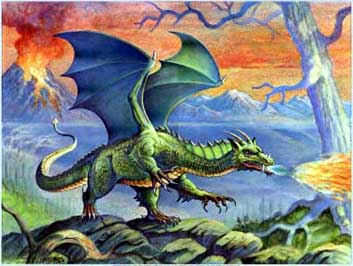
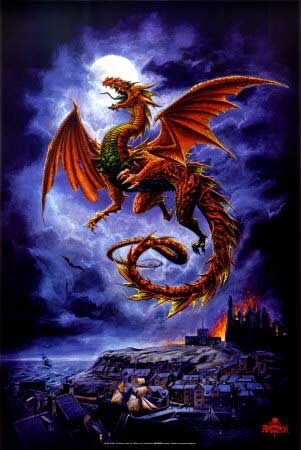
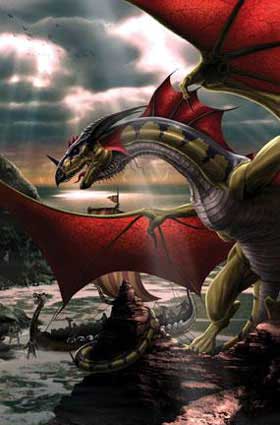
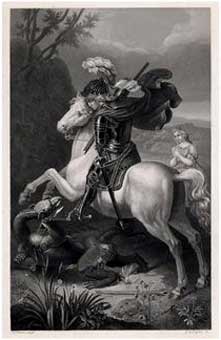
Dragons have appeared in mythology and legend for thousands of years in almost every country around the world. And the fact that the creature was truly regarded as an actual monster rather than a myth can be demonstrated in several writings of the day. Edward Topsell, writing in his Historie of Serpents (1608), commented that among all the kinds of serpents, there is none comparable to the Dragon, or that afforded and yielded “so much plentiful matter in history for the ample discovery of the nature thereof.”
Could it be that the Western dragon developed from a memory in the collective unconscious of modern man, a memory of other, widespread, fierce and fearsome animals, survivors from the age of dinosaurs — a memory passed down from our primitive ancestors, who lived in terror of such creatures? In the 19th century, fossil evidence of the existence of the pterodactyl, an extinct winged reptile, led to speculation that dragons, far from being purely mythical, may at one time have been real monsters that had survived from the age of the dinosaurs. A few scientists today regard the theory that a number of dinosaurs could have survived into the Age of Man. Pick up any book on dinosaurs and it is obvious that a Tyrannosaurus Rex would have made a terrific dragon in anyone’s legend. Such a huge reptile thudding about the countryside of early Europe or Asia could certainly fit even the most extraordinary descriptions of a dragon.
A more acceptable theory is that ancient historians were in reality describing huge snakes such as the python, which often reaches a length of more than 30 feet. Still, this does not account for descriptions of the dragon’s feet or its ability to walk on all fours. A more believable theory is that large ancient bones discovered in those times — such as dinosaur fossils, giant cave bear skulls, mammoths and woolly rhinoceros skeletons — could have been mistaken for dragon remains, fueling all manner of stories and folklore.
In the book Mythical Monsters(1886) New Zealand geologist Charles Gould declared: "We may infer that it (the dragon) was a long terrestrial lizard, hibernating and carnivorous... possibly furnished with wing-like expansions...."
A discovery that took place in 1912 gave some support to Gould's theory. A Dutch pilot who crash-landed on the island of Komodo in Indonesia reported seeing huge, grotesque-looking, carnivorous creatures resembling dragons. Investigations confirmed the airman's story. The animal he had seen was a giant monitor lizard, now known as the Komodo dragon. The creature grows to 12 feet in length, has a long powerful tail, feeds on carrion, and sometimes attacks and kills people. From New Guinea, too, have come unconfirmed reports of lizards that are even larger than the Komodo dragon. It is, however, difficult to understand how these particular giant lizards, isolated in a part of the world remote from Europe, could have played any part in the development of the Western legend of the dragon.
Nevertheless, people in Durham (England) still sing of the 'worm' — Old English for 'dragon' — which terrorized the county in the Middle Ages. It all began when the young heir to Lambton Castle went fishing on a Sunday. He caught an eel-like creature, which he threw down a well. In the well the worm grew to an enormous size, and when the young knight went off on a crusade, it broke out and devoured men and beasts. Every night it would sleep while wound three times around Lambton Hill, now called Worm Hill. Young Lambton managed to slay the dragon on his return from the crusade, but only by promising a witch he would kill the first creature he met after his victory. Unfortunately, it was his father who was first on the scene. Young Lambton refused to kill him, and, because of this, the Lambton family was put under the witch's curse — a curse said to be effective still.
This website is best viewed with the latest
versions of
Microsoft
Internet Explorer or
Firefox.
Occultopedia
makes extensive use of
Flash and Scripting in its pages and interface. Make certain your browser
permissions are set
accordingly and that you have the latest
Flash plug-in for the full experience, proper look and accurate
layout. You can do it with confidence. This site does not contain any viruses, malicious software
or scripts.
Occultopedia is the genuine article, the
original and the best internet index of the extraordinary and uncanny,
shamelessly copied by many, but never equaled. Online since 1995 — at first in a free web space provider
(Tripod.com), and in 1997 finally
with its own domain name and hosting — Occultopedia still is the
principal online resource for those looking for the unexplained, the
curious and the unusual.
Occultopedia respects your privacy. As
such, no cookies or any other tracking software will be installed as a
part of this website's original programming. I do not seek to obtain any personal information
beyond what is volunteered through electronic communications
(e.g. emails & forms).
Occultopedia may appear to be a for profit site, but my site is
not in reality a commercial one. All of the commercial links are from affiliate
programs, and the little revenue I get from these is to pay for hosting,
bandwidth — that can be quite costly if you have a lot of traffic, graphics and
pages — and any other expenses related to Occultopedia's upkeep, support, and maintenance.
For more details, visit my
ordering
information page.
Occultopedia is a
FREE online
resource available to the whole world. Usage of my word definitions and articles
by educational institutions, teachers and students alike, is here by granted.
Reproduction for profit, and for display in another web site is strictly
forbidden, and will be handled as copyright infringement and prosecuted to the
full extent of the law. However, if you follow
some simple guidelines,
I will grant permission for limited reproduction. For more information, please consult my
intellectual property rights, warranties and
disclaimers information page. Support Occultopedia and make it your
online shopping
destination. If you prefer, you can also make a donation.
HELP FOOT THE BILL: this website
is created and maintained by one guy, who also pays the hosting bill.
Please donate if you like and/or use Occultopedia.
Participate in Occultopedia and submit a word
definition or article for the occult encyclopedia at my
entry submission
page. If you would like to suggest a web site or page for
addition into Occultopedia's links database, please go to my
URL submission page.






 .
. .
.